
If you are looking for a Maze Balance Board for Kids Toddlers review, this one stands out because it is not just a wobble board.
It combines balance training with a maze game, so the challenge stays interesting long enough for kids to keep moving.
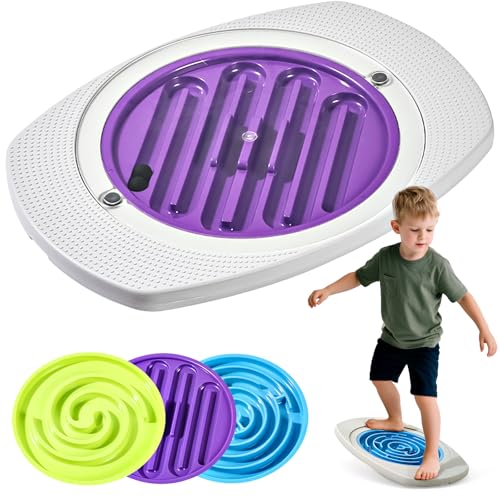
Maze Balance Board for Kids Toddlers Review Summary
The Maze Balance Board for Kids Toddlers is best viewed as a hybrid active-play toy: part wobble board, part ball maze, part sensory outlet.
That mix makes it a stronger fit than a plain balance board for families who want something that can hold a child’s attention while still pushing core balance, coordination, and gentle precision.
Buy it if you want indoor movement, a screen-free activity, and a toy that supports balance practice without feeling like exercise equipment. It is especially relevant for children ages 3 and up who like to fidget, move, climb, or focus on hands-on tasks.
The seller positions it as a giftable, versatile piece for preschool play, sensory breaks, skate and board-sport prep, and ADHD focus training.
Review Scorecard
| Category | Score | Rationale |
|---|---|---|
| Balance Training Value | 8/10 | The wobble-board format directly supports core strength, stability, and coordination. |
| Engagement | 9/10 | The maze and balls add a game layer that makes repeat use more likely. |
| Indoor Play Usefulness | 8/10 | It is clearly built for active play inside, including rainy-day and screen-free use. |
| Safety and Stability | 7/10 | Non-slip cushioning, rounded edges, and a stated 140 lb hold add confidence, though supervision still matters. |
| Sensory Appeal | 8/10 | The bumpy top and balance movement give it a clear sensory-training angle. |
| Versatility | 8/10 | It can support balance practice, imaginative play, and sport-prep habits. |
| Value for Families | 7/10 | The 3-in-1 concept and included parts add utility beyond a basic wobble board. |
Key Features and Specifications of Maze Balance Board for Kids Toddlers
The listing describes this as a 2-in-1 balance board and maze game, with a 3-in-1 design that includes 2 balls and 3 replacement labyrinth boards.
The board is intended to support balance training while also requiring concentration and gentle precision to guide the ball through the labyrinth.
Key listed details include:
| Feature | What the listing says |
|---|---|
| Primary use | Balance training, core strength, coordination, active indoor play |
| Age range | Recommended for children ages 3 and up |
| Included parts | 2 balls, 3 replacement labyrinth boards |
| Capacity | Holds up to 140 lbs |
| Motion | 30-degree rocker tilt |
| Materials | Smooth CPSC-certified PP+PE plastic |
| Safety details | Rounded edges, non-slip bottom, anti-slip cushioning |
| Comfort detail | Bumpy top designed to massage little feet |
The product page also highlights a triangular solid support structure and says the board will not tip over from left or right shaking under normal use.
That is useful if you are comparing it with simpler wobble toys that feel less anchored.
The biggest practical advantage is that the toy has two layers of use.
Kids can stand, rock, and balance on it, but they can also sit or crouch to work the maze.
That variety matters because some children lose interest in pure balance boards quickly.
Here, the puzzle element can keep them engaged longer.
The material and construction details suggest a child-focused product rather than a generic exercise accessory.
Rounded edges, anti-slip padding, and the stated certification language all point toward indoor family use instead of training-gym use.
Pros and Cons of Maze Balance Board for Kids Toddlers
Pros
- The maze feature gives the board a second purpose beyond wobbling.
- It supports balance, gross motor skills, and coordination in one setup.
- The screen-free design makes it easy to use for indoor active play.
- The board includes multiple labyrinth boards and balls, which increases replay value.
- The non-slip base and rounded edges are sensible child-focused design choices.
- The 140 lb capacity broadens the age and size range within the stated child audience.
Cons
- It is still a kids’ toy, so adults looking for a serious balance trainer will want something more specialized.
- Maze parts can frustrate younger children if they want instant movement instead of careful control.
- The best use case is indoor play; it is not a substitute for outdoor gross motor activity.
- Like most wobble toys, it depends on supervision and space around it.
The upside is clear: this is a product with more staying power than a single-use balance disc.
The downside is also clear: if your child only wants to stand and rock, the maze layer may not matter much.
Who Should Buy Maze Balance Board for Kids Toddlers?
This is a strong choice for parents who want a toy that encourages movement without a screen.
It fits toddlers and young kids who need a reason to stay engaged while building balance and coordination.
It should also appeal to families who like toys with a sensory or developmental angle.
The listing specifically connects it to ADHD focus training, sensory breaks, and skate or snowboard prep, so it is positioned for children who benefit from active, hands-on repetition.
Good buyers include:
- Parents of active kids ages 3 and up
- Families looking for indoor gross motor play
- Gift buyers who want a toy with both fun and developmental value
- Households that want a balance toy with a puzzle element
Skip it if:
- You want a pure sports training board with no toy element
- Your child prefers quiet tabletop puzzles over movement
- You need a device for outdoor or advanced athletic training
- You want something that works without any supervision
For most families, the question is not whether it is useful.
It is whether your child is likely to use it often enough to justify the floor space.
The answer is more likely to be yes if your child likes climbing, balancing, and fiddling with moving parts.
Balance and Play Experience of Maze Balance Board for Kids Toddlers
Wobble First, Puzzle Second
The board’s main appeal is that children are asked to do two different things at once: balance their bodies and manage the ball maze.
That combination is more cognitively demanding than simple rocking, and it is probably why the product can hold attention better than many basic balance boards.
Indoor Energy Release
This is the kind of toy that makes sense on a rainy day or during a long indoor stretch.
It gives kids a way to burn energy without turning the room into a running zone.
That makes it useful for households that want active play but do not have room for larger climbing equipment.
Sensory and Focus Use
The listing’s focus on sensory training and ADHD support is plausible because the board asks for movement control, visual attention, and hand-eye coordination.
It is not a medical tool, but it does give children a structured physical task that can feel calming and absorbing.
Sport-Prep Potential
The reference to surf and snowboard stances suggests a loose sport-prep angle rather than serious athletic coaching.
That is fair.
The board can help children practice stability and body awareness, but it should be seen as a playful foundation, not a replacement for actual sport instruction.
Alternatives to Maze Balance Board for Kids Toddlers
If you want to compare it against simpler or more established options, these Amazon search pages are the most relevant starting points:
- Rocker balance board
- Kids wobble board
- Labyrinth balance board
- Wobble cushion for kids
- Balance board for toddlers
Compared with a plain rocker board, the Maze product offers more engagement because of the maze challenge.
Compared with a wobble cushion, it gives a fuller standing and movement experience.
And compared with a standard toddler balance board, it is more playful and likely more appealing to children who need an extra reason to keep using it.
Is Maze Balance Board for Kids Toddlers Worth It?
Yes, if you want a child-friendly balance board that does more than wobble. The Maze Balance Board for Kids Toddlers is worth considering because it blends motor-skill practice with a maze game, which makes the toy easier to revisit and harder to outgrow quickly.
It is not the best pick for someone who only wants a simple balance trainer.
But for families that want indoor activity, sensory value, and a toy that feels closer to play than exercise, it is a sensible buy.
The combination of non-slip design, included maze boards, and broad age suitability makes it a practical option for active kids.