
Weighted running sleds add progressive resistance to sprints, pulls, pushes, and strength circuits without requiring complex equipment. The right model can help athletes build acceleration, leg drive, and work capacity while fitting the available training space and budget.
This roundup compares 10 sleds across adjustable sand-filled designs, compact resistance trainers, harness-ready options, and heavier steel models. Use the buying guide below to match capacity, construction, and training style to your goals.
Best 10 Weighted Running Sleds Picks for 2026
Speed-Training Resistance Sled

- Padded harness for resistance training
- Supports sprint and sport drills
- Weights not included
Best For: Athletes building speed, leg power, and endurance
Adjustable Sandbag Sled

- Includes four removable sandbags
- Adjusts up to 40 pounds
- 360-degree belt ring for multidirectional work
Best For: Athletes wanting adjustable sand resistance
Plate-Loaded Steel Sled

- Accepts one- and two-inch plates
- Steel construction with rust-resistant surface
- Includes adjustable belt and shoulder pads
Best For: Plate owners training speed and athletic strength
Compact Sandbag Resistance Sled
Adjustable Weight Sled Trainer

- Three fillable bags load up to 30 pounds
- Supports multidirectional training
- Suitable for wood, grass, and turf
Best For: Speed and lower-body workouts with adjustable resistance
Obstacle-Ready Pick

- Fits both 1-inch and 2-inch plates
- Curved base helps clear uneven terrain
- Adjustable shoulder straps included
Best For: Outdoor speed and strength drills on varied surfaces
Portable Variable-Load Pick

- Adjusts from 10 to 30 pounds
- Three removable sand bags included
- Supports multidirectional pulling
Best For: Portable speed training with quick resistance changes
High-Capacity Pick

- Supports up to 500 pounds
- Fits both standard and Olympic plates
- Built for indoor and outdoor surfaces
Best For: Heavy, progressive resistance training across varied terrain
Best Overall
- Fits both 1-inch and 2-inch plates
- Padded adjustable harness
- Durable steel frame for varied surfaces
Best For: Versatile push, pull, and drag training
Best Adjustable Resistance
- Adjusts from 10 to 60 pounds
- Twin design helps balance the load
- Water-resistant fabric for outdoor use
Best For: Running and agility training with sand resistance
Best Olympic Plate Option

- Built for 2-inch Olympic plates
- Dual holders improve load balance
- Quick-switch push-pull bar
Best For: Plate-loaded athletic strength and speed training
Speed-Training Resistance Sled – Power Speed Sled with Harness
For athletes comparing weighted running sleds, this Power Speed Sled offers a straightforward way to add resistance to sprints, running drills, and sport-specific conditioning. Its padded harness is designed for comfortable weighted training, while the load can be adjusted to match your workout needs. Weights are not included.
Best For: Athletes and fitness enthusiasts focused on speed, leg power, stride length, and endurance.
Pros:
- Padded harness supports weighted resistance training.
- Suitable for running, aerobics, football, soccer, and tennis drills.
- Resistance can be adjusted by adding the amount of weight that fits your training.
Cons:
- Weights are not included.
- The listed product dimensions are limited to a 23.5-inch measurement, so storage and setup space should be considered.
This is a practical choice if your priority is harness-based sprint resistance and flexible sport conditioning rather than a complete plate-loaded sled kit.
Adjustable Sandbag Sled – NAIZEA Weight Sled Trainer
This NAIZEA model is one of the more flexible weighted running sleds for users who want adjustable resistance without loading plates. It includes four removable sandbags, each holding up to 10 pounds, allowing a total load of up to 40 pounds when filled. Sand is not included.
Best For: Sprinters, football players, and athletes training speed, lower-body strength, mobility, and explosiveness.
Pros:
- Four removable bags allow adjustable resistance from 10 to 40 pounds.
- PVC construction is designed for grass, turf, and wood floors.
- 360-degree belt ring supports multidirectional training.
- Includes an adjustable leash, waist belt, and one-year warranty.
Cons:
- Sandbags require separate sand or filler.
- Maximum supported load is 40 pounds.
The included bags make this a convenient option for progressive training, especially when you want to vary resistance and add directional changes to your workouts.
Plate-Loaded Steel Sled – GanFindX Workout Weight Sled
For shoppers seeking weighted running sleds that use gym plates, the GanFindX Workout Weight Sled is built to accept both one-inch and two-inch weight plates. Its curved bottom and flat oval tubes are intended for use across runways, gyms, and lawns, while the adjustable belt includes soft shoulder pads.
Best For: Athletes who want a durable, plate-loaded sled for speed and strength training across multiple venues.
Pros:
- Compatible with one-inch and two-inch weight plates.
- Curved-bottom design is intended to move through different training venues.
- Adjustable safety belt includes soft shoulder pads.
- Steel construction has a smooth, rust-resistant surface and includes a two-year manufacturer warranty.
Cons:
- Weight plates are not listed as included.
- Assembly is required, although the product includes a hexagonal spanner and instructions.
This sled suits buyers who already own compatible plates and prefer a sturdy steel platform with adjustable harness support over a sandbag-based design.
Compact Sandbag Resistance Sled – Adjustable Weight Sled Trainer
This adjustable trainer is a compact choice among weighted running sleds, using three fillable PVC sandbags to create 10 to 30 pounds of resistance. Its moisture-resistant PVC body and secured straps are intended for wood floors, grass, and turf, while the 360-degree belt loops support multidirectional exercises.
Best For: Soccer players, sprinters, and adult or older-kid users who want adjustable resistance for speed and lower-body training.
Pros:
- Three fillable bags provide adjustable loading up to 30 pounds.
- 360-degree belt loops support changes in direction and mobility work.
- Can be used on wooden floors, grass, and turf.
- Includes a one-year warranty and moisture-resistant PVC materials.
Cons:
- Sand or other filler is not included.
- Its maximum listed load is 30 pounds, lower than some larger sled systems.
This model is a sensible pick for varied drag workouts when you want a lighter, easily adjustable setup for indoor or outdoor training.
Obstacle-Ready Pick – Kipika Workout Weight Sled
The Kipika Weight Sled is a practical option among weighted running sleds for athletes who want adjustable resistance with standard or Olympic weight plates. Its curved base is designed to move across uneven areas while helping protect lawns and carpets.
Best For: Speed, agility, and strength training on lawns, carpets, and sports surfaces.
Pros:
- Supports both 1-inch and 2-inch weight plates.
- Curved elliptical base helps navigate obstacles and uneven terrain.
- Adjustable shoulder straps support resisted running and pulling drills.
- Steel buckles and a sturdy frame are suited to repeated training.
Cons:
- Weight plates are not listed among the included components.
- At approximately 10.6 pounds, it is less portable than lighter fabric sleds.
Choose this model if protecting the training surface and handling uneven ground matter as much as adding resistance. Its plate compatibility also makes it adaptable as your workouts progress.
Portable Variable-Load Pick – SKLZ SpeedSac Training Sled
The SKLZ SpeedSac is one of the more portable weighted running sleds for athletes who want resistance that can be adjusted without carrying metal plates. Three removable sand bags let you set the towing load from 10 to 30 pounds.
Best For: Sprinters, football players, and athletes training lower-body power on grass, turf, or wood.
Pros:
- Three removable bags provide three resistance levels up to 30 pounds.
- 360-degree belt ring supports multidirectional training.
- Adjustable leash and waist belt fit different athletes.
- Nylon shell and secured straps are designed for use on several surfaces.
Cons:
- Sand is not included.
- Its 30-pound capacity may be limiting for advanced heavy-drag workouts.
This is a convenient choice when fast load changes and easy transport are priorities. It offers less maximum resistance than plate-loaded sleds, but the variable sand-bag design is useful for progressive speed work.
High-Capacity Pick – SELEWARE Weight Sled
The SELEWARE Weight Sled is a high-capacity option among weighted running sleds, with support for up to 500 pounds and compatibility with both standard and Olympic plates. Its steel construction and curved, flat-surface tubes are intended for indoor and outdoor training.
Best For: Beginners through advanced athletes who want heavy, adjustable resistance across varied training surfaces.
Pros:
- Rated to hold up to 500 pounds.
- Includes support bars for 1-inch and 2-inch plates.
- Designed for gyms, grass, turf, tracks, concrete, and asphalt.
- Curved ends and flat elliptical tubes help handle uneven terrain and protect surfaces.
Cons:
- Weight plates are not listed as included.
- At approximately 10.5 pounds, the metal sled is relatively heavy to transport.
- The broad surface compatibility may still require care on delicate flooring.
For buyers seeking room to grow, this sled stands out for its stated capacity and dual plate support. It is best suited to a dedicated training setup where heavier resistance and surface versatility outweigh minimal portability.
Best Overall – VEVOR Weight Sled
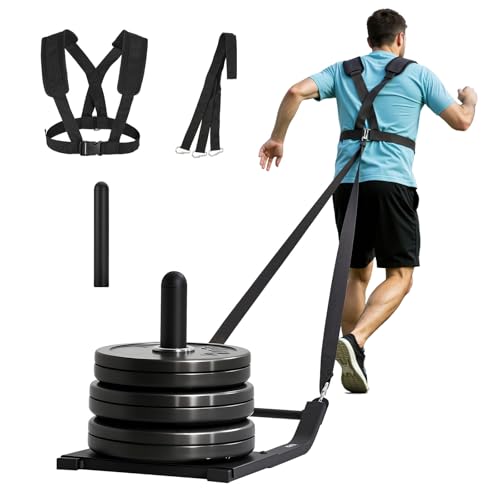
For shoppers comparing weighted running sleds, the VEVOR Weight Sled is a versatile steel option for push, pull, and drag workouts. It accepts both 1-inch and 2-inch weight plates, glides across several surfaces, and includes a padded adjustable harness for more comfortable training.
Best For: Beginners and experienced athletes who want a durable, plate-loaded sled for outdoor or gym workouts.
Pros:
- Supports both 1-inch and 2-inch standard weight plates.
- Includes a thicker padded harness with adjustable shoulder straps.
- Dual front pull hooks help provide steadier dragging.
- Powder-coated steel construction is rated for loads up to 276.6 pounds.
Cons:
- Weight plates are not listed as included.
- Its steel construction may be less convenient to carry than a fabric sled.
The VEVOR stands out for broad plate compatibility and a sturdy, compact design. It is a practical pick when you want one sled for strength, speed, and dragging sessions across different training surfaces.
Best Adjustable Resistance – Elite Twin Sand Bag Sled
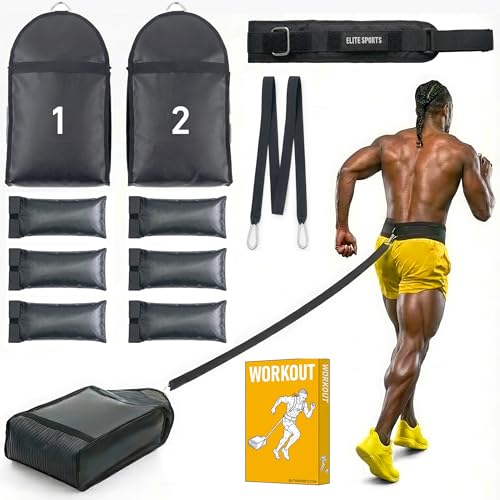
Among weighted running sleds, the Elite Twin Sand Bag Sled offers adjustable resistance without requiring weight plates. Its twin-sled layout uses removable sandbags to create 10- to 60-pound training levels, while the waterproof fabric construction suits outdoor running and conditioning.
Best For: Runners and field-sport athletes who want adjustable resistance with a waist-mounted pulling system.
Pros:
- Six resistance levels range from 10 to 60 pounds.
- Twin sleds and separate pouches help distribute weight evenly.
- Water-resistant PU-PVC-coated polyester is designed for indoor and outdoor use.
- Padded adjustable waist straps support running, sprinting, and agility work.
Cons:
- Ships empty; sand is not included.
- It is limited to sand-based loading rather than standard weight plates.
This model is a flexible choice for progressive running resistance and does not require a plate-loaded setup. Factor in the need to source and fill the sandbags before training.
Best Olympic Plate Option – TE DEUM Pull Sled
The TE DEUM Pull Sled is a straightforward choice for weighted running sleds when your setup already uses Olympic plates. Its extra-thick alloy-steel frame, dual plate holders, and quick-switch push-pull bar are designed for controlled strength and speed training.
Best For: Athletes with 2-inch Olympic plates who want a steel sled for pushes, pulls, and drags.
Pros:
- Designed specifically for standard 2-inch Olympic weight plates.
- Dual plate holders help distribute the load and reduce wobble.
- Quick-switch bar changes push-pull direction with minimal interruption.
- Includes a nylon harness and reinforced steel D-rings.
Cons:
- Only suitable for 2-inch weight plates.
- Warranty coverage is listed as three months.
The TE DEUM is best suited to a dedicated Olympic-plate training space. Its balanced rack and reversible bar prioritize efficient transitions during power, endurance, and speed sessions.
How We Picked the Best Weighted Running Sleds
We focused on practical features that affect training results and everyday usability: resistance capacity, adjustment options, sled construction, included accessories, portability, and the type of surface each design is likely to handle. We also considered whether a sled supports pulling, pushing, or both, since those movements place different demands on the frame, harness, attachment points, and user.
Adjustable sandbag systems received attention for their flexibility, while steel power sleds can be a better fit for athletes who need a more durable platform for repeated training. Compact variable-weight models may suit lighter conditioning sessions or users with limited storage space.
Quick Comparison
| Best For | Look For |
|---|---|
| Speed and acceleration work | Low-profile design, smooth drag, and a secure harness or strap |
| Progressive strength training | Higher load capacity and a rigid steel frame |
| Home gyms and limited storage | Compact dimensions, removable weights, and easy transport |
| Flexible conditioning circuits | Adjustable sandbags or multiple resistance settings |
| Outdoor training | Durable materials, reinforced attachment points, and weather resistance |
Key Buying Factors for Weighted Running Sleds
Resistance and Adjustability
Check the maximum load and how resistance is changed. Sandbag systems are convenient when you want several incremental settings, while plate-compatible sleds may offer more precise loading if you already own weight plates. Remember that surface friction changes the effective resistance, so maximum advertised weight is only one part of the performance equation.
Construction and Attachment Points
Look for reinforced welds, sturdy connection points, and a base designed for the surfaces you use. A sled intended for grass, turf, or track work may not perform identically on concrete or rough pavement. Confirm whether the package includes a harness, straps, bags, or only the sled frame.
Portability and Storage
Compact sleds are easier to carry between the gym and field, but larger frames may track more consistently under heavy loads. Consider total packed weight, foldability, and whether empty sandbags or detachable components simplify storage.
Training Compatibility
For sprint work, smooth resistance and a comfortable harness matter most. For strength-focused sessions, prioritize load range and durability. If you plan to push as well as pull, verify that the frame has suitable handles or push posts rather than assuming every drag sled supports both movements equally well.
Who Should Buy Which Weighted Running Sleds?
Choose a compact adjustable model if you are new to sled training, need straightforward home workouts, or want resistance that is easy to scale. Athletes focused on acceleration should favor a lightweight, low-profile sled with a reliable harness and smooth movement. Field-sport players may benefit from a versatile sandbag sled that supports repeated speed and conditioning drills.
For serious strength training, frequent use, or heavier progressive loading, a steel sled with robust attachment hardware is generally the better long-term choice. Buyers who train outdoors should prioritize weather-resistant materials and confirm that the sled’s base matches their training surface. Before purchasing, compare the complete package—not just the frame—to ensure the included weights and accessories support your intended workouts.